Paper
LoRA: Low-Rank Adaptation of Large Language Models
Edward J. Hu et al. · arXiv
TL;DR
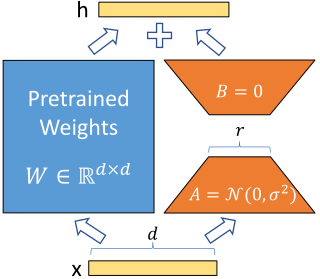
Full fine-tuning copies every weight of a large model for each new task. LoRA leaves those weights frozen and learns a low-rank update: two small matrices whose product is added to a weight matrix during the forward pass. The stored task is the small update, not a second full checkpoint.
Why it matters
Hu et al. point at GPT-3 175B as the motivating case. Keeping an independent fine-tuned copy of a model that size, for every task, is too expensive to deploy. Low-rank adapters made specialization cheap enough to run many tasks from one frozen base model, which is why the method spread through open fine-tuning.
Key takeaways
- The pretrained weights stay fixed. Only the low-rank factors are trained.
- A rank much smaller than the layer dimension is enough for the adaptations they study.
- At inference, the update can be folded into the original weight so latency matches a fully fine-tuned model.
- Switching tasks means swapping the small adapter, not reloading a full parameter set.