Paper
Training language models to follow instructions with human feedback
Long Ouyang et al. · arXiv
TL;DR
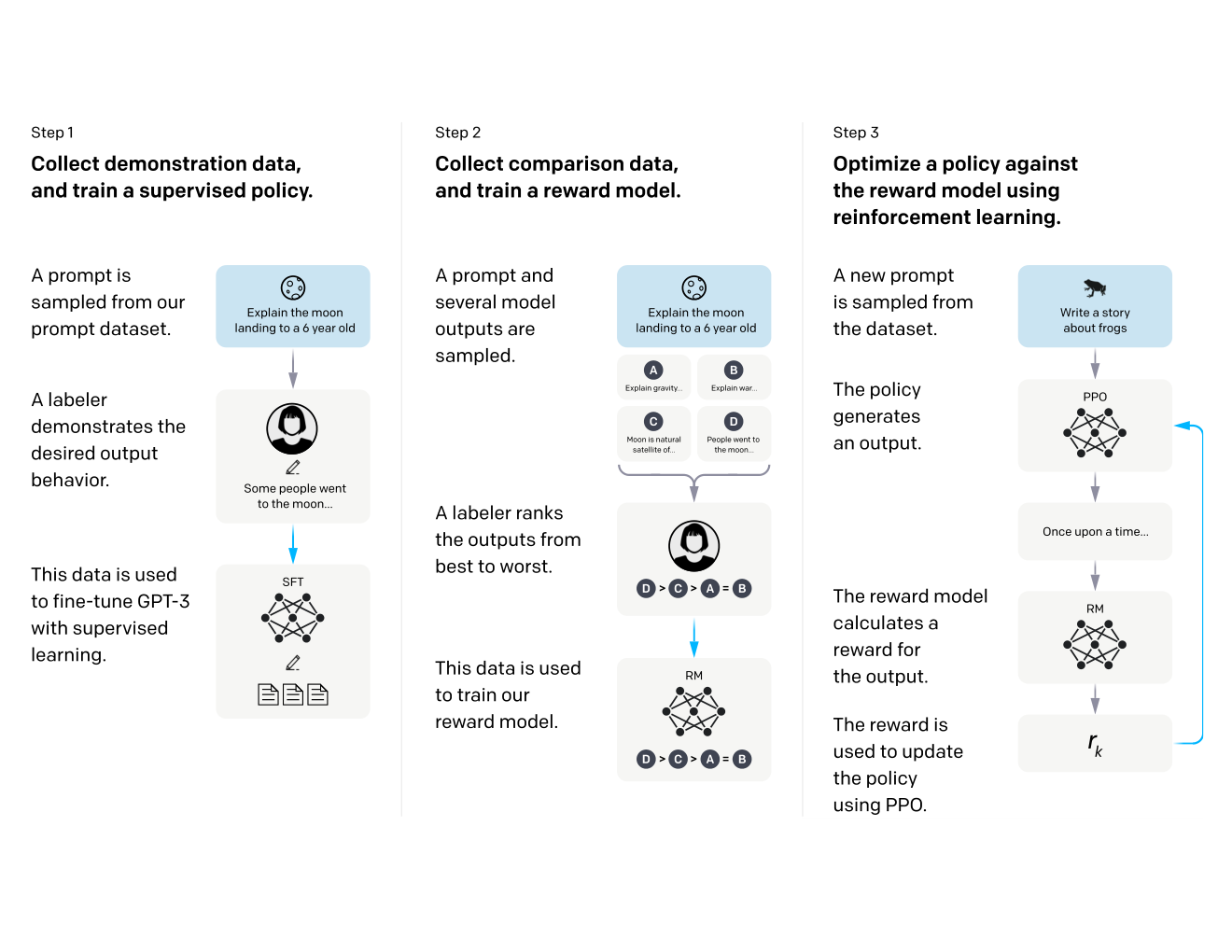
Ouyang et al. start from GPT-3 and train it to follow instructions. Labelers write demonstrations of the desired behavior, which supervise a first fine-tune. Labelers then rank model outputs, those rankings train a reward model, and reinforcement learning from that reward produces InstructGPT.
Why it matters
A larger next-token model is not automatically a better assistant. The paper's human evaluations say the 1.3B InstructGPT outputs were preferred to the 175B GPT-3 on their prompt distribution, despite having far fewer parameters. Alignment, in this recipe, is a fine-tuning problem with human feedback, not a side effect of scale.
Key takeaways
- Supervised fine-tuning on demonstrations is the first step.
- A reward model is trained on rankings of several outputs for the same prompt.
- PPO then updates the policy against that reward, with a penalty that keeps it from drifting too far from the supervised model.
- The authors report gains in truthfulness and lower toxicity on the measures they use, and they also say the models still make simple mistakes.