Paper
Chain-of-Thought Prompting Elicits Reasoning in Large Language Models
Jason Wei et al. · arXiv
TL;DR
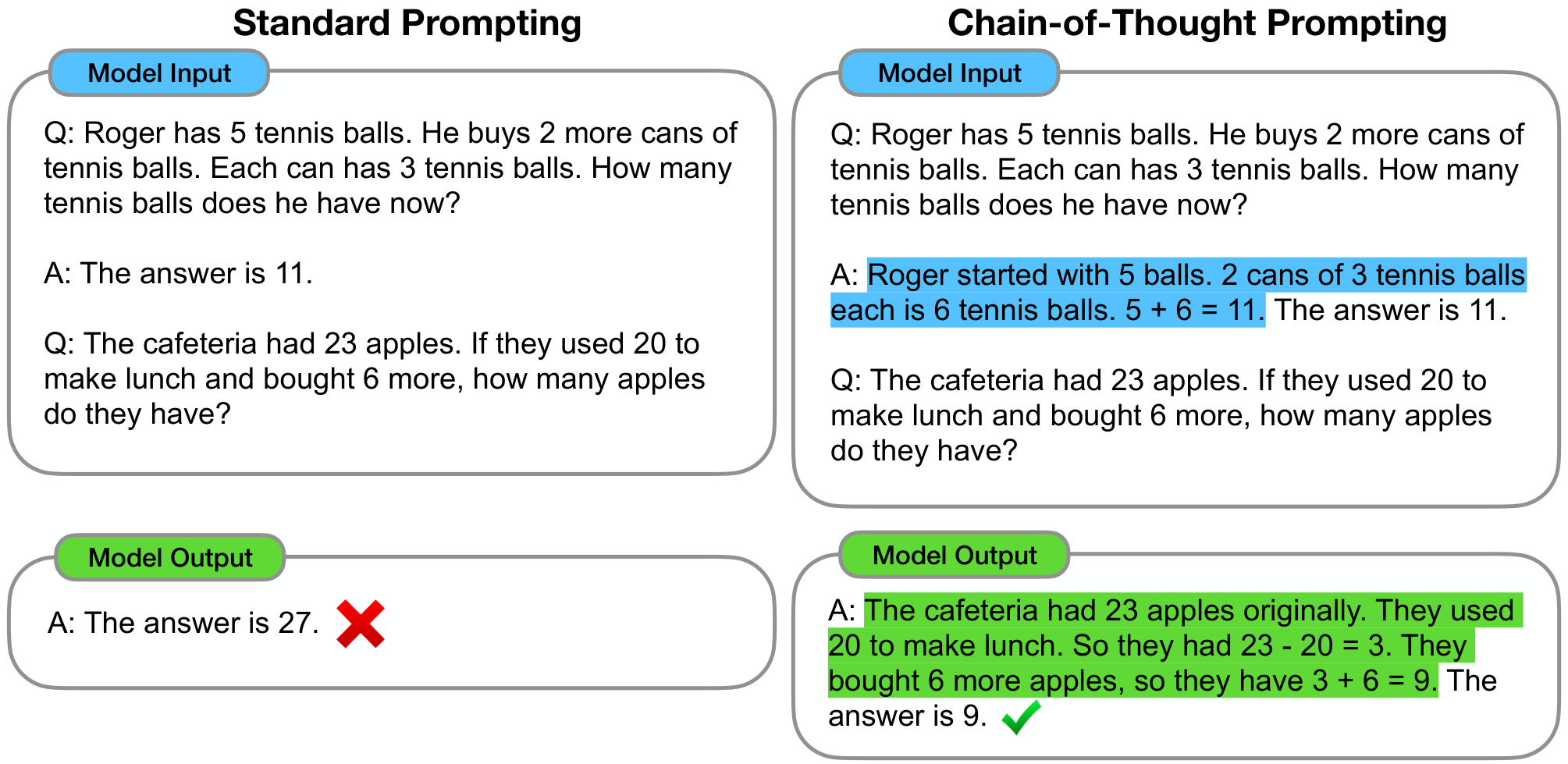
Wei et al. prompt a language model with a few examples that include the intermediate steps, not only the final answer. The model then writes its own steps before the answer. On sufficiently large models, that chain of thought improves multi-step arithmetic, commonsense, and symbolic reasoning.
Why it matters
Standard few-shot prompts ask for an answer in one jump. That fails when the task is a sequence of calculations. Chain-of-thought prompting showed that the reasoning format in the prompt is a lever by itself: no extra fine-tuning, just exemplars that show the work. Later reasoning systems still start from that idea.
Key takeaways
- A chain of thought is a series of intermediate steps written in natural language.
- The gain shows up as models get larger. Small models do not reliably benefit.
- The method is prompting, not a new architecture or a labeled reasoning dataset.
- The paper's experiments cover three large language models and several reasoning benchmarks, including grade-school math.